Tour: JWST Deployment
This tour takes you though the launch and deployment of the observatory. We effectively replay the mission landmarks that occurred between launch and first light.
This includes following JWST from Earth to its destination orbit around the Earth-Sun Lagrange point 2 (L2), and the unfurling of the spacecraft’s sunshield and mirror. All of this is animated in realtime as it happened in the mission. Finally, we end the tour with first light and first science images, six months after launch.
Important
: Flight instructions
: Turn on a data set
: Turn off a data set
: Adjust a setting
: Target an object
: Change the time settings
Profile Edit items (NOTES FOR BRIAN)
Turn off trails for everything
Remove ISS trail and other space station trail
This figure shows the overall mission milestones that were necessary to execute before first light. Its 30-day journey out the L2 was a harrowing process of deployment of various parts of the spacecraft, alignment of the mirrors, and testing of the components. Any one of hundreds of processes could have hampered the mission, but everything performed flawlessly.

The JWST launch timeline and deployment schedule. From launch, it took about 30 days to reach its orbit around L2. Along the way, the sun shield, antenna, and mirrors of the telescope were deployed.
Mission Panel
This tour can be used with the Mission Panel. In the JWST Profile, the Mission Panel automatically shows JWST’s milestones from launch to its first deep field image six months later.
Each milestone has a brief description, and an accompanyong image if one is available.
Rather than wait for the time to advance to each milestone, you can click the button in the Mission Panel to automatically set the time in OpenSpace to the time of each milestone. This allows you to page through each milestone while advancing OpenSpace to that time inn the mission.

The Mission Panel showing the JWST milestones. Here, we see the milestone for January 23, 2022, when it arrived and was inserted into it’s orbit around Lagrange point 2. Use the interactive timeline to explore milestones, and the button to go to that time in OpenSpace.
Pretour Checklist
Start the tour by launching OpenSpace with the profile.
Open the Mission Panel with the
 button.
Launch
Target JWST in the Navigation Panel using JWST’s target button

Fly to JWST manually or by using a transition in the Navigation Panel:
 or


We begin our tour on launch day, December 25, 2021.
When you fly up to JWST a few things will be immediately obvious. One, we are not rendering a rocket. You will see a model of JWST and can follow along as it’s launched into space, but you’ll have to use your imagination that a rocket is taking it there.
Two, the Earth terrain is severely pixelated. This is done intentionally because the launch site in French Guiana is censored for security reasons. All maps will show this area as blurred.
Click the December 2021 Launch Milestone in the Mission Panel timeline.

Unpause time
Fly away and orbit around JWST to get a better view
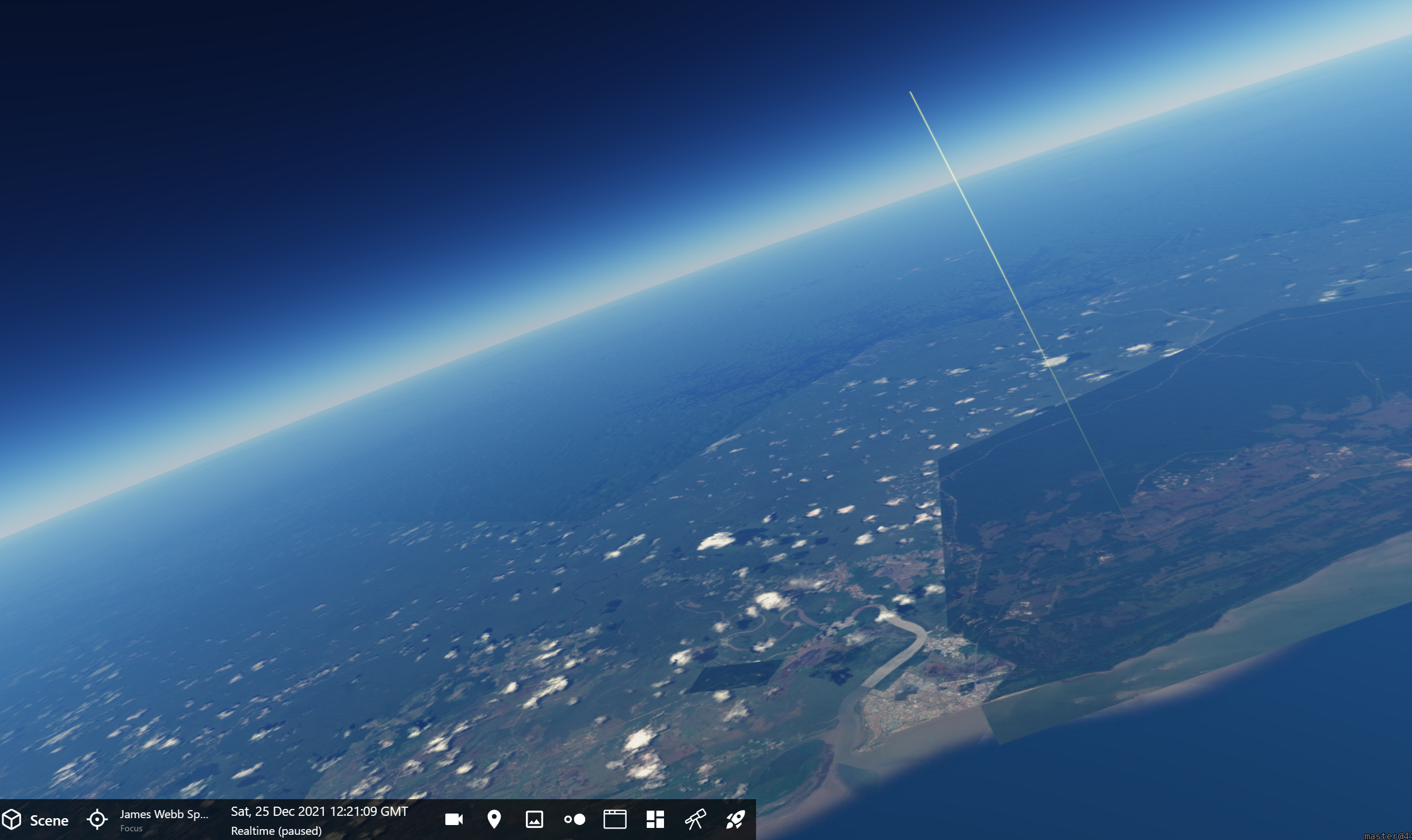
Fly closer to get a sense you’re riding along with the telescope as it passes over Earth

Use the Quick Adjust slider in the Time Panel to move time forward if you like. You can also use the Space bar to pause and resume time.

At 27 minutes after launch, picured above, the telescope separated from the rocket’s upper stage and began its journey toward L2. It will take about 30 days to get there.
About 12 hours after launch, the telescope’s rockets began firing for 65 minutes to put it in a trajectory toward the L2 point one million miles away.
Sun Shield Deployment

Three days after the launch, engineers began to unfurl the telescope’s sun shield. This will protect the mirror and detectors from the Sun’s light and heat.

It took several days to fully deploy the sun shield.


Secondary Mirror
After deploying the two mid booms, each taking over 3 hours to move into place, the secondary mirror was lowered on January 5, 2022.
The primary mirror’s wings, still partially folded below, were rotated into place on January 7 and 8, 2022. In this screenshot, one side is rotated into place, while the other side will be rotated on January 8.

On Its Way to L2
Continue to move around JWST at varying distance to gain perspective on the trajectory toward L2

JWST takes about 30 days from launch to when it enters its orbit around Lagrange point 2 (L2).
Entering Its Orbit Around L2
Click the January 2022 Arrival at L2 Orbit Milestone in the Mission Panel timeline.

On January 24 19:00 UT, JWST’s rockets fired their third course correction in order to insert the telescope in orbit around the L2 point.
Here, the trajectory from Earth’s perspective becomes orange, and there is a purple trail that shows the telescope’s trajectory from L2’s point of view.
First Light
Click the February 2022 NIRCam Detected the First Photons Milestone in the Mission Panel timeline.
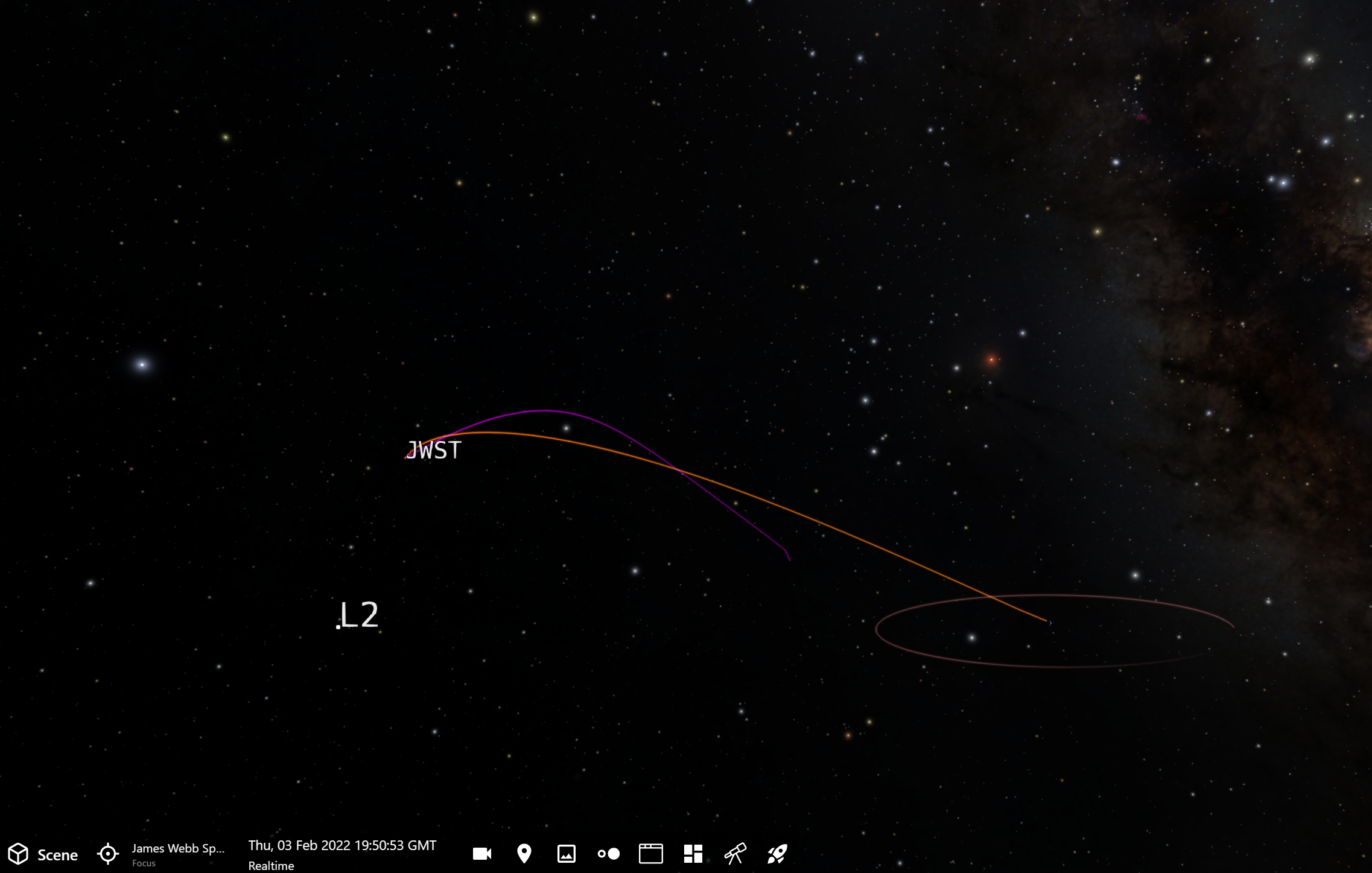
Once the sun shield was deployed, it took weeks for the mirror and instruments to cool down sufficiently. When the mirror reached -153°C (-244°F or 120 Kelvin), the arduous process of aligning the mirrors could begin.
On February 3, 2022, first light occurred on JWST. Photons were detected, though a coherent image would require the mirror alignment.
First Image & Mirror Alignment
Click on the March 2022 First Phasing Alignment Milestone in the Mission Panel timeline

Mirror alignment took about a month, but once it was complete the telescope acted as one mirror instead of 18 individual mirrors. The star HD 84406 in the constellation Ursa Major was the first target and was used to align the mirrors.
Click on the April 2022 Alignment Complete Milestone in the Mission Panel timeline

Mirror alignment was complete on April 24, 2022.
First Deep Field Image Released
Click on the July 2022 First Deep Field Image Released Milestone in the Mission Panel timeline
The first deep field image was releasd on July 11, 2022 of a 4.6-billion-light-year distant cluster of galaxies.
Two Orbits, Same Moment
Here, we show where JWST was on July 11, 2022. However, we render two different orbits. The first is the orbit from Earth’s perspective, which shows the trajectory from Earth out to the location of the spacecraft in its orbit around L2.

This next image shows JWST’s orbit from the perspective of someone at the L2 point.

The telescope does not sit in one stable position at L2, it actually is in orbit around that point. And, the orbit is not stable, so JWST must do periodic corrections to maintain its orbit around L2.
Conclusion
In the end, hundreds of operations had to perform flawlessly in order for JWST to live up the high engineering standards. With six month of calibrations, it was a painstaking operation to be sure everything was working to spec so that the mission was deemed a success. From shipping it from California to South America through the Panama Canal, to the hundreds of deployment steps and release mechanisms, JWST will capture our imagination and advance the scientific frontier in ways we have yet to envision.